Yes its me that guy who keeps talking about all of the great
books at Salem House Press! Today we will look at Felix Valloton and his pioneering efforts in woodcuts.
Felix greatly admired the works of
Holbein,
Dürer and
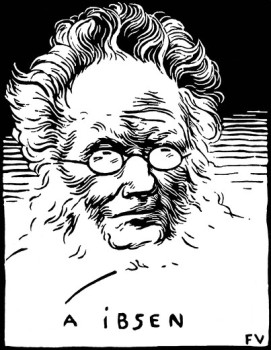
Ingres; these artists would remain exemplars for Vallotton throughout his life. In 1891 he executed his first woodcut, a portrait of
Paul Verlaine.
The many woodcuts he produced during the 1890s were recognized as
innovative, and established Vallotton as a leader in the revival of true
woodcut as an artistic medium.
In the western world, the
relief print, in the form of commercial
wood engraving,
had long been utilized mainly as a means to accurately reproduce drawn
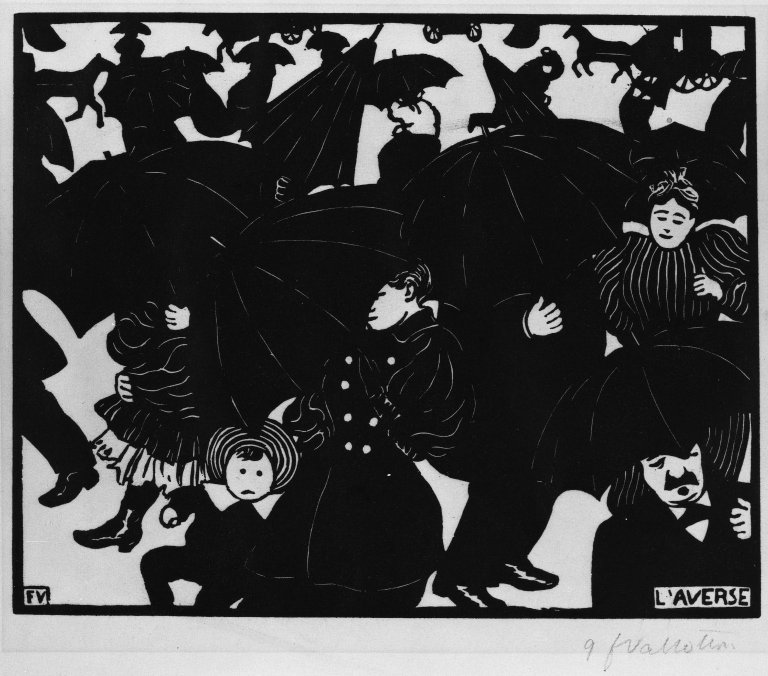
or painted images and, latterly, photographs. Vallotton's woodcut style
was novel in its starkly reductive opposition of large masses of
undifferentiated black and areas of unmodulated white. Vallotton
emphasized outline and flat patterns, and generally eliminated the
gradations and modeling traditionally produced by
hatching. He was influenced by
post-Impressionism,
Symbolism, and especially by the
Japanese woodcut: a large exhibition of
ukiyo-e prints had been presented at the
École des Beaux-Arts in 1890, and Vallotton, like many artists of his era an enthusiast of
Japonism, collected these prints.

La raison probante (The Cogent Reason), a
woodcut from the series
Intimités, 1898
His woodcut subjects included domestic scenes, bathing women,
portrait heads, and several images of street crowds and
demonstrations—notably, several scenes of police attacking anarchists.
He usually depicted types rather than individuals, eschewed the
expression of strong emotion, and "fuse[d] a graphic wit with an acerbic
if not ironic humor".
Vallotton's graphic art reached its highest development in
Intimités (Intimacies), a series of ten interiors published in 1898 by the
Revue Blanche, which deal with tension between men and women.
Vallotton's woodcuts were widely disseminated in periodicals and books
in Europe as well as in the United States, and have been suggested as a
significant influence on the graphic art of
Edvard Munch,
Aubrey Beardsley, and
Ernst Ludwig Kirchner.
By 1892 he was affiliated with
Les Nabis, a group of young artists that included
Pierre Bonnard,
Ker-Xavier Roussel,
Maurice Denis, and
Édouard Vuillard,
with whom Vallotton was to form a lifelong friendship. During the
1890s, when Vallotton was closely allied with the avant-garde, his
paintings reflected the style of his woodcuts, with flat areas of color,
hard edges, and simplification of detail. His subjects included
genre scenes, portraits and nudes. Examples of his Nabi style are the deliberately awkward
Bathers on a Summer Evening (1892–93), now in the
Kunsthaus Zürich, and the symbolist
Moonlight (1895), in the
Musée d'Orsay.
Now what I enjoy is his use of simultaneous contrast. He is a master of leading your eye from white shape to white shape through large expanses of black that never give up the shape of the objects they are depicting. He gets so much bang for his buck with so little expense. See what you think...
Now this is the end of my sampling from Felix Valloton. I hope you enjoyed him!
~ Chris
For more of about that quirky illustrator from
Salem and his
books, go back and hit the blue highlighted text.Yes, now! Go on do it. I dare you.