Welcome

Please enjoy the wacky world my pencils and paints create for you. As an illustrator I try to bring you a world in which you have not read before or have seen in movies yet. My minds eye comes from behind the curtain in that chocolate factory that Willie Wonka didn't let you peer behind. Now I am opening it for you! Come in and take a look...

Monday, April 28, 2014

Arkham and H.P. Lovecarft

 "What lay behind our joint love of shadows and marvels was, no doubt, the ancient,
mouldering, and subtly fearsome town in which we live - witch-cursed, legend-haunted
Arkham, whose huddled, sagging gambrel roofs and crumbling Georgian balustrades
brood out the centuries beside the darkly muttering Miskatonic."
Thing on the Doorstep

Some of you might know already Lovecraft's strong connections to Salem. For those who do not know yet, let me fill you in.

Lovecraft first journey to Salem in April of 1923. Arkham is the home of Miskatonic University, which figures prominently in many of Lovecraft's works. The institution finances the expeditions in both At the Mountains of Madness (1936) and The Shadow Out of Time (1936). Walter Gilman, of The Dreams in the Witch House (1933), attends classes at the university. Other notable institutions in Arkham are the Arkham Historical Society and the Arkham Sanitarium. It is said in Herbert West—Reanimator, the town was devastated by a typhoid outbreak in 1905. Arkham’s most notable characteristics are its gambrel roofs and the dark legends that have surrounded the city for centuries.


Danvers State Hospital is the basis for his Arkham Sanitarium. Later the Batman universe will borrow that mythos and rename it Arkham Asylum. In 1992, the same year the old Salem Jail was closed, they shut their doors and sent the patients walking to Salem's homeless shelter. Both buildings are now luxury condos.... Only in Salem! In 2012 my friend Jon Archer actually took a cupola from the building and attached it to a new wing on his mansion. He also appropriated one of their lobotomy kits amidst many other architectural artifacts he incorporated in his new wing. Danvers State Hospital is said to have performed the first lobotomy.


Other Buildings and the quotes they are mentioned in from his stories....


Crowninshield-Bentley House

Asenath had bought the old Crowninshield place in the country at the end of High Street, and they proposed to settle there after a short trip to Innsmouth, whence three servants and some books and household goods were to be brought. (“The Thing on the Doorstep”)


The Derby House 

We discussed certain possible arrangements for his moving back into the Derby mansion, and I hoped that he would lose no time in making the change. He did not call the next evening, but I saw him frequently during the ensuing weeks. We talked as little as possible about strange and unpleasant things, but discussed the renovation of the old Derby house, and the travels which Edward promised to take with my son and me the following summer. (“The Thing on the Doorstep”)

 Charter Street Burial Ground, Salem
 
....you know Pickman comes of old Salem stock, and had a witch ancestor hanged in 1692. (“Pickman’s Model”)


Danvers State Hospital 

Before long I was pretty nearly a devotee, and would listen for hours like a schoolboy to art theories and philosophic speculations wild enough to qualify him for the Danvers asylum. (“Pickman’s Model”)

  I’ve heard personally of more’n one business or government man that’s disappeared there, and there’s loose talk of one who went crazy and is out at Danvers now. (“The Shadow Over Innsmouth”)


So as you walk through the streets and dark corners of Salem, be careful. Be aware! You never know when one of his critters might be stalking up on you.....


 ~Chris

To find out more about Chris and his peculiar habits visit his page filled with fun games and animation. Then check out his publishers page to see a list of his books and the works of his friends at Salem House Press. Also check out the cool site dedicated to The Salem Trilogy!

Saturday, April 26, 2014

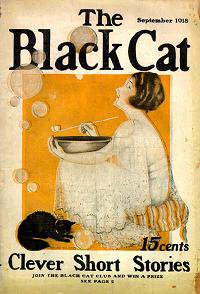
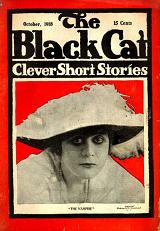
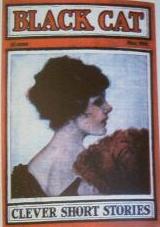
Black Cat Magazine~Pulp Fiction from the Witch City

The Black Cat Magazine was started in 1895 in Boston  under the editorial eye of Herman Daniel (H.D.) Umbstaetter of  Salem , Massachusetts. It initially focused on strange fantasy stories and welcomed contributions from first-time writers. Science fiction writer Clark Ashton Smith first got his start in its pages. The most notable neophyte writer to launch his career in The Black Cat was Jack London, whose short story A Thousand Deaths was published in May 1899 and earned him $40.

In 1912 the Black Cat was moved to Salem as the city was transforming into the Witch City. What better timing. Umbstaetter died in 1913 and the editorial reigns passed through a few more hands before resting in those of Harold E. Bessom in 1915. At the start of 1919, Black Cat announced the beginning of the Black Cat Club. BCC membership allowed subscribers to submit critiques of stories that appeared in the magazine, and would pay one penny a word in return. The club folded by the end of the year.

Henry Miller first learned of this "club" when he happened to purchase a 15-cent copy of the January 1919 issue of The Black Cat.  Although Henry Miller did not write any stories for the magazine, he did have 5 critiques published. Upon payment of his first critique he was so happy he threw his hat in the air. It landed in traffic and that was the end of that hat....

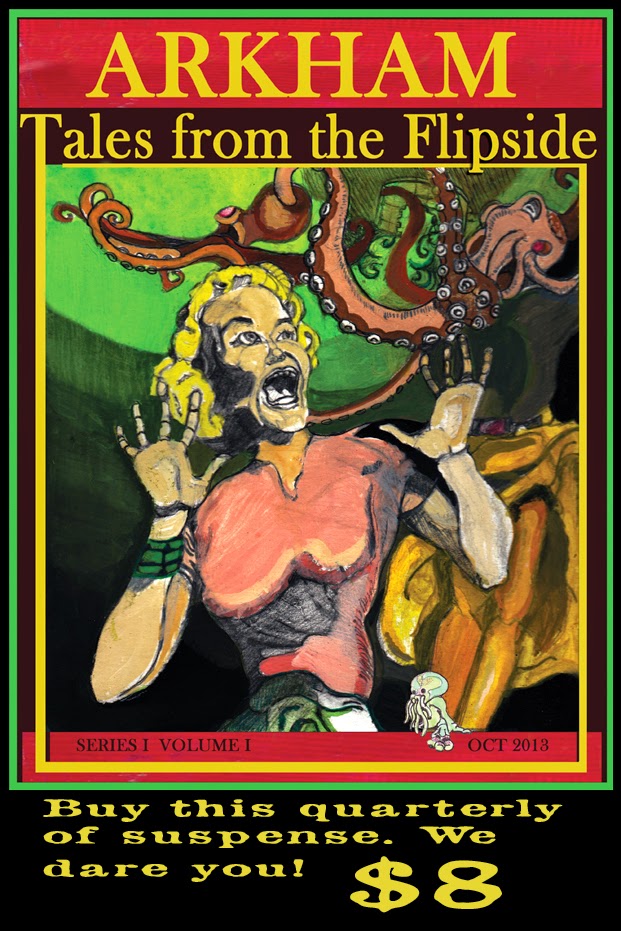
The last issue of the Black Cat was published in 1922 in NYC. Although this is not the end of clever short stories with gripping illustrations. In Oct 2013 Salem House Press published Arkham: Tales from the Flipside . Pulp fiction covering sci-fi, horror, humorous narrative, and fantasy. They are offering emagazine subscriptions on their website. On their page they also give offer a free audio cast of stories by Ray Bradbury, Philip K. Dick, Isac Asimov, Robert A. Heinlein, and more.


 ~Chris

To find out more about Chris and his peculiar habits visit his page filled with fun games and animation. Then check out his publishers page to see a list of his books and the works of his friends at Salem House Press. Also check out the cool site dedicated to The Salem Trilogy!
Tuesday, March 4, 2014

The Dancing Fool and Happiness!

Hello everyone,
For those who know me they will not be surprised to see me burst out in dance anywhere good music is! I almost lost a girlfriend who ran away from me when I started dancing in the local mall while and Irish band played in the corridor... Oh well! I should of let her keep running and kept dancing and smiling! My next girlfriend understood and she found this amazing book about dancing and happiness!
I Hope You Dance 
(http://www.goodreads.com/book/show/31315.I_Hope_You_Dance_With_I_Hope_You_Dance_CD_)

OK, for those who do not know me, here is a sneak peak....

 Crazy Legs at The Lowell Folk Festival

Now you will understand why I am going to share the video below. Pharell Williams has put together 24 hrs of people dance as happy as I do! The first video will give you a taste what it is like to dance and be happy! If you are hooked, you might want to watch the 4 hour video. If you become an addict, you might go for the full 24 hrs. Imagine that! If you can watch the full 24 hrs you truly have danced your way to happiness! Enjoy!

4 Min Video

4 Hour Video
http://www.youtube.com/watch?v=u_75VGPxUPI

24 Hour Video
http://24hoursofhappy.com/

Pass it around!

 ~Chris

To find out more about Chris and his peculiar habits visit his page filled with fun games and animation. Then check out his publishers page to see a list of his books and the works of his friends at Salem House Press. Also check out the cool site dedicated to The Salem Trilogy!
Thursday, January 23, 2014

New Book Available: Max Teller's Amazing Adventure.

Hello,
Here is another tale from the warped side of my brain...

Every child dreams about flying, but when have we ever gotten the chance to do so... Max did though. Max Teller is a precocious boy who was left in a precarious predicament one fine afternoon. Can you even imagine what soup this child got himself into? Alas not, then I will tell you.

Have you not desired that one day you could be brave enough to fly? Of course you have, we all have been children. Some people like myself in an advanced age remain one to this day. My envy for Mr. Teller can not be rivaled, for he indeed flew! Oh he did not start off so brave, nor was it a journey he asked for, but one that called him!

Read our tale today and find out if Max what happens to Max!

The Print version will not be available till March, but you can buy the Kindle version on Amazon Today!
Go for it!


 ~Chris

To find out more about Chris and his peculiar habits visit his page filled with fun games and animation. Then check out his publishers page to see a list of his books and the works of his friends at Salem House Press. Also check out the cool site dedicated to The Salem Trilogy!

Fairies!

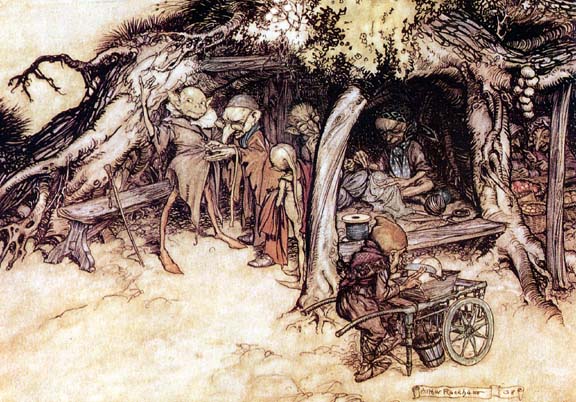
Arthur Rackham created the world of fairies, elves, gnomes and the other woodland creatures. He influenced Alan Lee and Brian Froud. His critters filled children's head for nearly a century now!

Arthur Rackham

Arthur Rackham is widely regarded as one of the leading illustrators from the 'Golden Age' of British book illustration which encompassed the years from 1900 until the start of the First World War. During that period, there was a strong market for high quality illustrated books that typically were given as Christmas gifts. Many of Rackham's books were produced in a de luxe limited edition, often vellum bound and sometimes signed, as well as a larger, less ornately bound quarto 'trade' edition. This was often followed by a more modestly presented octavo edition in subsequent years for particularly popular books. The onset of the war in 1914 curtailed the market for such quality books, and the public's taste for fantasy and fairies also declined in the 1920s.
Arthur Rackham's works have become very popular since his death, both in North America and Britain. His images have been widely used by the greeting card industry and many of his books are still in print or have been recently available in both paperback and hardback editions. His original drawings and paintings are keenly sought at the major international art auction houses.

Technique

Rackham invented his own unique technique which resembled photographic reproduction; he would first sketch an outline of his drawing, then lightly block in shapes and details. Afterwards he would add lines in pen and India ink, removing the pencil traces after it had dried. With colour pictures, he would then apply multiple washes of colour until translucent tints were created. He would also go on to expand the use of silhouette cuts in illustration work, particularly in the period after the First World War, as exemplified by his Sleeping Beauty and Cinderella.[4]
Typically, Rackham contributed both colour and monotone illustrations towards the works incorporating his images - and in the case of Hawthorne's Wonder Book, he also provided a number of part-coloured block images similar in style to Meiji era Japanese woodblocks.
Rackham's work is often described as a fusion of a northern European 'Nordic' style strongly influenced by the Japanese woodblock tradition of the 19th century.


May the Real Wyeth Stand Up!

We all know Andrew Wyeth and his sons...
But their father made dreams!


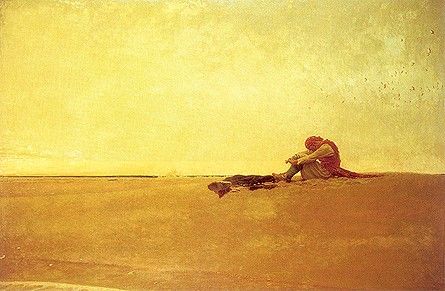
N.C. Wyeth

Newell Convers Wyeth (October 22, 1882 – October 19, 1945), known as N.C. Wyeth, was an American artist and illustrator. He was the pupil of artist Howard Pyle and became one of America's greatest illustrators.[1] During his lifetime, Wyeth created over 3,000 paintings and illustrated 112 books,[2] 25 of them for Scribner's, the Scribner Classics, which is the work for which he is best known.[1] The first of these, Treasure Island, was one of his masterpieces and the proceeds paid for his studio. Wyeth was a realist painter just as the camera and photography began to compete with his craft.[3] Sometimes seen as melodramatic, his illustrations were designed to be understood quickly.[4] Wyeth, who was both a painter and an illustrator, understood the difference, and said in 1908, "Painting and illustration cannot be mixed—one cannot merge from one into the other


Here Is One of My Favorite Illustrators

Howard Pyle

I got to visit his Brandeywine School two summers ago. His work was amazing. Unfortunately the Wyeth's have taken it over....

In 1894 he began teaching illustration at the Drexel Institute of Art, Science and Industry (now Drexel University). After 1900, he founded his own school of art and illustration, named the Howard Pyle School of Illustration Art. The scholar Henry C. Pitz later used the term Brandywine School for the illustration artists and Wyeth family artists of the Brandywine region, several of whom had studied with Pyle.[1] Some of his more notable students were N. C. Wyeth, Frank Schoonover, Elenore Abbott, Ethel Franklin Betts, Anna Whelan Betts, Harvey Dunn, Clyde O. DeLand, Philip R. Goodwin, Violet Oakley, Ellen Bernard Thompson Pyle, Olive Rush, Allen Tupper True, Elizabeth Shippen Green, and Jessie Willcox Smith.
His 1883 classic publication The Merry Adventures of Robin Hood remains in print, and his other books, frequently with medieval European settings, include a four-volume set on King Arthur. He is also well known for his illustrations of pirates, and is credited with creating what has become the modern stereotype of pirate dress.[2] He published his first novel, Otto of the Silver Hand, in 1888. He also illustrated historical and adventure stories for periodicals such as Harper's Weekly and St. Nicholas Magazine. His novel Men of Iron was adapted as the movie The Black Shield of Falworth (1954). In 1905 he was elected into the National Academy of Design

Pictures From Howard Pyle

 ~Chris

To find out more about Chris and his peculiar habits visit his page filled with fun games and animation. Then check out his publishers page to see a list of his books and the works of his friends at Salem House Press. Also check out the cool site dedicated to The Salem Trilogy!